
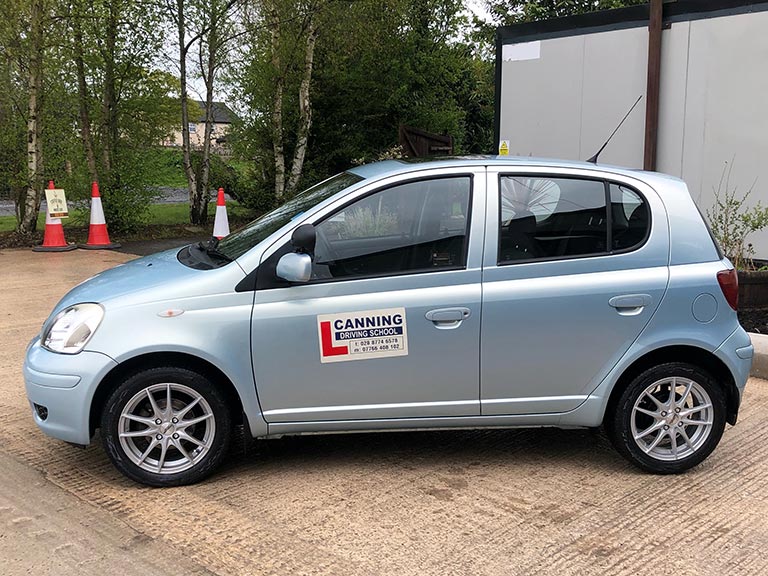
During your first lessons you will learn the basics and fundamentals of driving to help increase your confidence whilst driving. As you further your driving ability. The lessons will become increasingly diificult as the manouveres you must know and that you could be asked to preform on your driving test are introduced in the build up to you booking and sitting your test at one of the qualified testing centres.
Before you start the driving ability part of your test, you’ll have an eyesight check and be asked 2 vehicle safety questions.
You’ll have to read a number plate from a distance of:
You’ll be asked 2 vehicle safety questions. These are also known as the ‘show me, tell me’ questions.
The examiner will ask you one ‘show me’ question, where you’ll have to show them how you’d carry out a vehicle safety check.
You’ll also be asked one ‘tell me’ question, where you’ll have to explain to the examiner how you’d carry out the check.
The driving part of your test will last about 40 minutes. Throughout the test your examiner will be looking for an overall safe standard of driving.
During your test the examiner will give you directions that you should follow. You’ll drive in various road and traffic conditions. You should drive in the way your instructor has trained you.
It should include:
You’ll have to show how well you can reverse your vehicle. The examiner will ask you to do one of the following exercises:
Your driving test will include around 10 minutes of independent driving. It’s designed to assess your ability to drive safely while making decisions on your own.
If you make mistakes carry on if you make a mistake, because if it’s not a serious mistake it might not affect your result.
Your practical driving test will include around 10 minutes of independent driving. It’s not a test of your orientation and navigation skills.
During your test you’ll have to drive independently by either following:
It doesn’t matter if you don’t remember every direction, or if you go the wrong way.
Driving independently means making your own decisions - this includes deciding when it’s safe and appropriate to ask for confirmation about where you’re going.
It won’t affect the result of your test if you go off the independent driving route, unless you make a driving fault.
The examiner will help you get back on the route if you go off it or take a wrong turning. You can then continue with the independent driving.
The examiner will give you directions until you can see the next traffic sign if there are poor or obscured traffic signs. You won’t need to have a detailed knowledge of the area.
The examiner will tell you if you passed or not explain how you did during the test.
You’ll pass your test if you make:
There are 3 types of faults that can be marked: